

The Warning Shot and the Locked Door: When the Law Decides Whose Fear Counts
- justinemccarthy
- Apr 23
- 3 min read
Two women. Two guns. Two very different encounters with the American legal system.
In 2010, Marissa Alexander, a 31-year-old Black mother in Jacksonville, Florida, fired a single warning shot into the wall of her own home to stop her estranged husband Rico Gray from attacking her again. Gray had a documented history of domestic violence against her. The shot hit no one. Nobody was hurt. And yet, a jury convicted her in twelve minutes, and under Florida's mandatory minimum sentencing law, she was handed 20 years in prison (Alexander v. State, 2013).
Twenty years. For a warning shot. Into a wall. In her own house.

Now fast forward to June 2, 2023. Susan Lorincz, a 60-year-old white woman in Ocala, Florida, fired a gun through her locked front door and killed Ajike "AJ" Owens, a 35-year-old Black mother of four, standing outside, unarmed, knocking on the door. Owens had come over after Lorincz allegedly threw roller skates at her children. Lorincz was not initially arrested. Prosecutors debated the charges for weeks before settling on manslaughter, not murder. She was eventually sentenced to 25 years (NBC News, 2024).
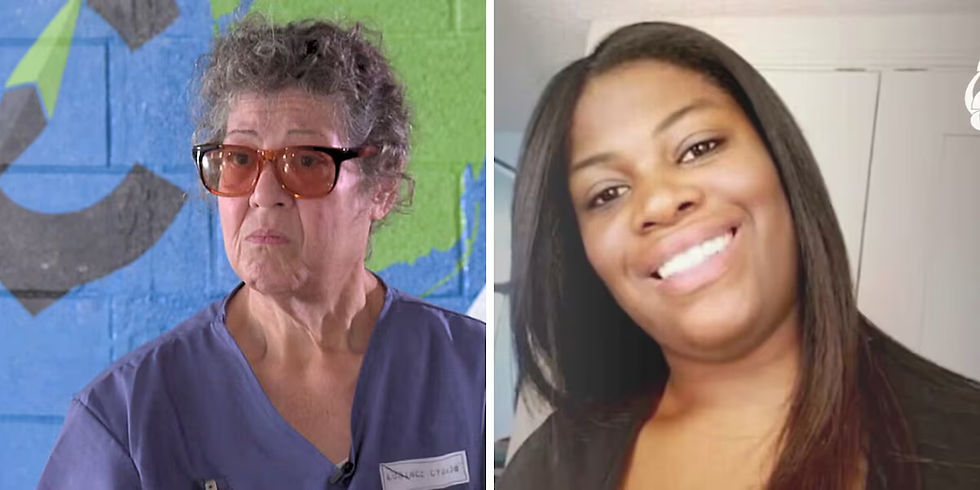
Alexander fired into a wall and harmed no one: 20 years. Lorincz fired through a locked door and killed a mother of four: 25 years, after weeks of prosecutorial hesitation. Let that sit with you.
Florida Has a Law for This. It Just Doesn't Apply Equally.
Florida's Stand Your Ground law says that if you reasonably believe you're in imminent danger, you can use force to defend yourself with no duty to retreat. On paper, this law was made for both of these women. In practice, it worked very differently depending on who was doing the fearing.
When Alexander tried to invoke Stand Your Ground, prosecutors argued she had voluntarily re-entered the situation by stepping outside to retrieve her gun and could not claim imminent danger. The jury didn't deliberate long. She was framed throughout the trial as an angry woman. Not a scared one.
When Lorincz shot through a locked door at an unarmed woman, the Marion County Sheriff's Office spent days investigating before making an arrest, carefully weighing whether Stand Your Ground protected her. That benefit of the doubt was never extended to Marissa Alexander.
This isn't just two bad outcomes. It's a pattern. Studies of Stand Your Ground cases suggest racial bias sits at the center of how the law is applied. Black women are not read as fearful. They are read as threatening. Their survival is reframed as aggression.
The System Didn't Start Here
This is not new. Historian Kali Gross has documented that historically, the justice system has not been on the side of Black women. Even after slavery ended, judges, juries, and police were overwhelmingly white men who did not take violence against Black women seriously, while punishing them to the fullest extent of the law. That dual standard is the ancestor of what happened to Marissa Alexander.
Mandatory minimum sentencing laws were sold as a race-neutral fix to judicial bias. The data tells a different story. According to the U.S. Sentencing Commission (2023), Black women receive significantly longer sentences than white women for comparable offenses. Remove judicial discretion and you don't remove racism. You just make it harder to name.
Marissa Alexander was released in 2015 under a plea deal after serving three years for a warning shot that hurt no one. AJ Owens will never be released from anything. Her four children are growing up without their mother.
What these cases share is a system that decides, along racial lines, whose fear is legible and whose self-defense is credible. That system has roots far deeper than any one law, and until we're honest about that, nothing will change.
The law didn't fail Marissa Alexander by accident. It worked exactly as it was built to.
References
Alexander v. State, 121 So. 3d 1185 (Fla. Dist. Ct. App. 2013). https://caselaw.findlaw.com/court/fl-district-court-of-appeal/1645234.html
Gross, K. N. (2006). Colored amazons: Crime, violence, and Black women in the city of brotherly love, 1880–1910. Duke University Press.
Li, D. K. (2024, November 25). Florida woman sentenced to 25 years for fatally shooting neighbor through door. NBC News. https://www.nbcnews.com/news/us-news/florida-woman-sentenced-25-years-fatally-shooting-neighbor-door-rcna181611
Mather, K. (2015, January 27). Marissa Alexander released from jail after plea deal in warning shot case. Los Angeles Times. https://www.latimes.com/nation/la-na-marissa-alexander-released-20150127-story.html
Owens, C. (2022). How Stand Your Ground laws failed Marissa Alexander. Essence. https://www.essence.com/news/how-stand-your-ground-laws-failed-marissa-alexander/
United States Sentencing Commission. (2023). Demographic differences in federal sentencing. https://www.ussc.gov/research/research-reports/2023-demographic-differences-federal-sentencing


Comments